How to install Windows 8 using a USB drive
Step-by-step guide to installing Windows 8 from a USB drive using the Windows 7 USB/DVD Download Tool, including tips on formatting, BIOS settings, and troubleshooting.
To get you started you will need an ISO image of Windows 8 and also the Windows 7 USB / DVD Download Tool which will help you put that image on the USB stick. You can download both of them by clicking their respective images below.
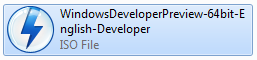

Install the Windows 7 USB Tool after download finishes. Don’t worry about the name of the program which says Windows 7, it works just fine with Windows 8 as well.
Now that you have all the needed files insert your USB drive into the PC, right click it and select format. Most tutorials I’ve seen say to format it to FAT32 otherwise it will not work — though when I use the tool to copy the Windows files to the USB drive, the tool formats my drive to NTFS. Strange, but whatever.
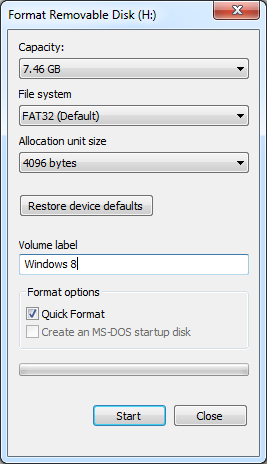
Quick format it as FAT32 and don’t forget to backup your data!
Now that you’ve formatted the USB drive open up the Windows 7 USB Tool, hit Browse and select the ISO image you’ve just downloaded.
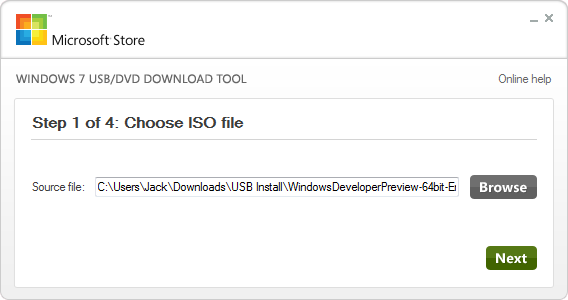
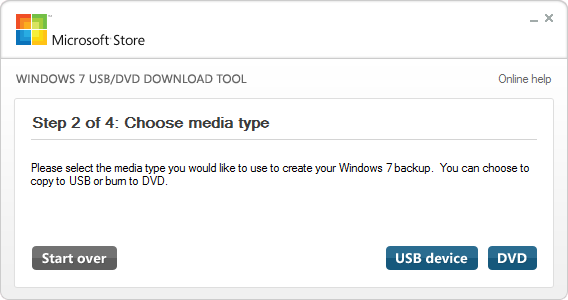
Click Next and on the next screen asking you to select the media type choose USB device. As you can see you are also given the option of writing the image directly to a DVD. For this how-to we will stick with the USB.
Choose the USB device on which you want the tool to put the install files and hit Begin copying.
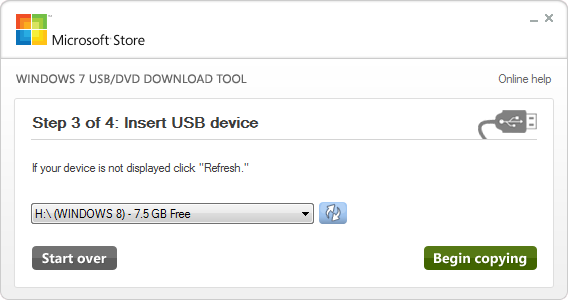
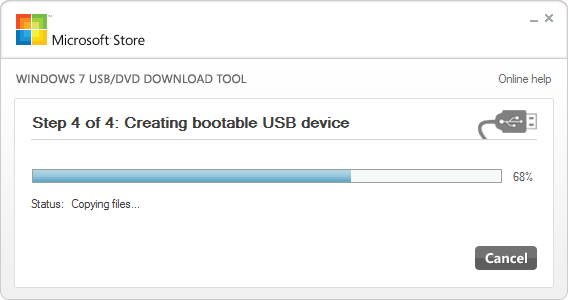
The tool will now start copying the Windows install files to your USB drive.
Once the entire process is complete and if you got no errors during it restart your computer, bring up your boot menu (F12 in my case – during POST) and select the USB drive. If your USB drive doesn’t show up in that list, go into your BIOS and make sure that Legacy USB Support is Enabled.
Notes:
- You cannot make a bootable USB drive with 64-bit Windows on it if you are currently running a 32-bit operating system. You need to have a 64-bit operating system in order to make a bootable USB drive with 64-bit Windows on it.
- The USB drive has to be large enough. 4 GB will do for the simple 32-bit and 64-bit versions, but for the 64-bit version containing the developer tools you will need an 8 GB drive – because the size of the ISO alone is 4.7 GB.
- Make sure you back up the data on that USB drive before formatting it. Otherwise it’s lost. Also, carefully choose the partition on which you install the OS so you don’t overwrite your existing Windows installation by mistake – because in this case also, all data will be lost.
And one last thing: Published from a fresh copy of Windows 8. So you know for sure that it works.